 David Souter, former U. S. Supreme Court Justice, will speak about the critical importance of funding humanities education and scholarship at the NY State Library in downtown Albany on September 12, 2013 on behalf of the New York Council on the Humanities.
Souter served on a special commission of the American Academy of Arts and Sciences which recently issued a report entitled, "The Heart of the Matter: The
Humanities and Social Sciences for a vibrant, competitive and secure
nation."
Showing posts with label museum. Show all posts
Showing posts with label museum. Show all posts
Friday, August 16, 2013
Supreme Court Justice David Souter in Albany

Monday, March 26, 2012
Not a Greatest Hits Package-- Bob Nickas

“I did not put the book together in the way a band might assemble a greatest hits package.” Instead, it’s an “idiosyncratic” collection that includes lesser-known artists, such as the now-defunct duo Wallace & Donohue, rather than, say, Jeff Koons.
Picture: "Changing My Tune" by Wallace & Donohue, 1980s.
Friday, March 23, 2012
Dissing the Patrons of Art-- Bob Nickas 3/26
 Bob Nickas, art critic who visits 3/26, has no problem biting the hand that feeds Art:
Wealthy and powerful people—and boring people, and famous people—use art and artists to legitimize themselves. Or they use culture to say, “Look how cultured I am. I gave all that money to the museum.” Or, “Look, I bought this painting for however many millions of dollars at that auction.” People in the art world, people around artists, they all do the same thing. They use art to advance themselves, to advance their careers, for fame, power, money, and all those things. The art world doesn’t function any differently from the business world, the banking world, the real estate world, the military, or politics. And all those people in banking and real estate? They’re all involved in art. And why are they involved in art? Because in banking and real estate, there are all these oversights. People can go to jail. People can pay fines. The art world is the only unregulated market of its kind. I mean, what are the other unregulated markets? Drugs, arms, and slavery? Prostitution and gambling? Art is the only white-collar, legitimized market that is completely unregulated. There are no penalties. The only thing that you’ll ever get caught for is tax evasion.
Read the interview with Jesse Pearson in Vice.
Thursday, November 17, 2011
Slaughtering Each Other by the Hundreds of Thousands
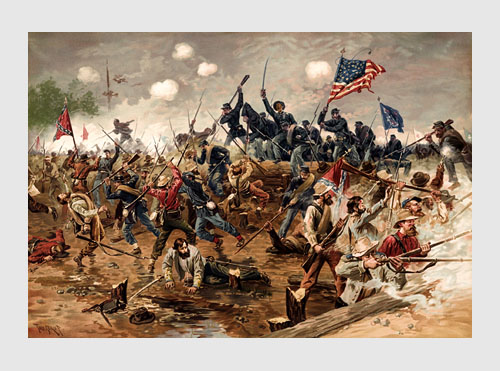 Tony Horwitz, who speaks at the New York State Museum tonight, talked Tuesday on the PBS NewsHour about his new book on John Brown's raid.
"I think we still struggle to understand how it is that Americans who shared a common language and culture and for the most part religion came to slaughter each other by the hundreds of thousands in the 1860s. And I think John Brown and his raid on Harpers Ferry give us a window into that story." More
Read More......
Wednesday, November 16, 2011
John Brown's Bloody Raid, Tomorrow, NYS Museum
 Tony Horwitz, Pulitzer-winning journalist, will present his bold retelling of John Brown's anti-slavery raid on Harper's Ferry, Virginia, tomorrow at the New York State Museum, free and open to the public.
November 17 (Thursday)Reading/Discussion — 7:30 p.m., Clark Auditorium, NYS Museum, Cultural Education Center.
Tony Horwitz, the featured speaker for the 2011 Researching New York Conference, will discuss his new book, Midnight Rising: John Brown and the Raid That Sparked the Civil War (2011). As a reporter for the Wall Street Journal, Horwitz received the Pulitzer Prize in 1994. He is the author of four national nonfiction bestsellers including A Voyage Long and Strange (2008), Blue Latitudes (2002), Confederates in the Attic (1998), and Baghdad Without a Map (1991).
Sponsored by UAlbany’s Department of History, the NYS Archives Partnership Trust, the NYS Writers Institute and NYS Museum. For additional information on the Researching New York Conference click here.
Neither Hero Nor Terrorist, or Maybe Both
 "When pressed to characterize Brown as an American hero or an American terrorist, Horwitz refused. 'He was neither,' he said. 'Or both. He was a complicated man.'"
The Washington Post Arts Blog covered Tony Horwitz's book release party last Saturday for Midnight Rising: John Brown and the Raid That Sparked the Civil War (2011). More.
Horwitz speaks tomorrow, Thursday, Nov. 17, at the New York State Museum downtown.
Friday, November 11, 2011
Albany, the Promised Land
 "The Albany that migrants discovered upon arrival from the Deep South was a city on the move. The 1930 census placed the state capital's population at 127,412, with 98 percent white and 86 percent native born.... New arrivals found housing in Albany's oldest neighborhoods along the river. These neighborhoods were composed of row houses broken into apartments and shops. Once fashionable, these areas became worn after generations of newcomers to Albany getting their start and then with success moving on to better quarters and neighborhoods."
In connection with Isabel Wilkerson's visit to the Writers Institute on Nov. 15, it's interesting to read about the impact of the experiences of African Americans who came to Albany during the Great Migration. Jennifer Lemak, UAlbany graduate and Curator of History at the New York State Museum, has published some fascinating information on this period in the city's history
Read about the historic African American community on Rapp Road in the Pine Bush here.
Subscribe to:
Posts (Atom)